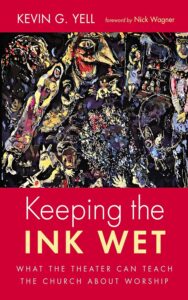
 Oscar Wilde famously opined that the altar server at Mass was what remained of the chorus from classical Greek tragedy. This may or may not be historically sound, but it highlights an important and frequently undervalued parallel between Christian liturgy and the stage: the origins of the theater as we know it are to be found in the drama of ancient Greece, participation in which was itself, originally, understood as a form of worship.
Fr. Kevin Yell has written a book exploring the connection between Christian worship and drama in unexpected ways that will be of value not only to members of the clergy, but to anyone involved in the planning and celebration of liturgical rites or other services of worship. He brings to this work a background in both theater and ministry that may well be unique.
Some will immediately object (as I did, quietly, before reading the book) that worship is not a “performance,” still less a form of “entertainment.” But to do so would be short-sighted, and would sell short both the Liturgy and the theater. Like liturgy, theater is about more than entertainment. It has the potential to challenge, to console, to change lives. And, like good theater, good liturgy requires thoughtful preparation and commitment on the part of those who are charged with its various ministries, and a familiarity with and sensitivity to those who will gather for the rite. Calling theater mere “entertainment” undervalues its potential and that of all the arts. And insisting that liturgy is not entertainment, and should not be guided by theatrical values, can – and often does – cloak an unwillingness to put in the work necessary to celebrate well.
The title of the book references a piece of thespian wisdom. A play is performed from a script, from words printed on a page in the past, whether recent or distant. The words will generally be the same in every performance. They may already have been spoken by other actors hundreds or thousands of times. And those words must be brought to life in performance now. This is the peculiar challenge of the actor. To keep the ink wet is to keep the words alive in performance, to embody them and speak them so that an audience can receive them in the present.
A cognate challenge exists in liturgy, given that liturgical worship, too, uses a sort of “script:” the ritual books of a given tradition. Here, too, words on a page that have been spoken innumerable times before must be expressed again now, in today’s celebration, in a way that gives them new life for those who participate in the rite. This is not about the validity of a given celebration, but about the aspiration to express as fully as may be the realities that liturgy embodies, and to engage as deeply as may be the hearts of those who participate. The Spirit blows where it will, regarding both good liturgy and bad. But good liturgy can, as it were, remove obstacles to the Spirit’s work in the human heart.
Readers of Fr. Kevin’s book will discover, as I was pleased to do, that the theater has much to teach the Church in this regard. And I suspect this will be the case regardless of where a given reader falls on the spectrum ranging between “creative” and “traditional” liturgy (inadequate and oversimplifying though such a representation of this spectrum may be).
A pervasive theme of Fr. Kevin’s book is that both good theater and good liturgy call for deep humility on the part of those who celebrate, serve, act, direct, or are otherwise involved. Just as a play is not “about” the actor cast in a staring role, so also and still more profoundly liturgy is not “about” the priest who celebrates, it is about the divine Logos, the Word made flesh, given and received in the context of the assembled community. Both the play and the rite, in very different but unmistakably related ways, are about more. Both the actor and the priest must yield centrality – even if they stand, in fact, at “center stage” or its liturgical equivalent – to the drama and the Mystery.
Fr. Kevin is also helpfully insistent on the practical realities behinds the scenes. If things like planning, rehearsal, set design, and front- and back-of-house operations are neglected in a theatrical production the result is obvious and embarrassing. But similar neglect tends to be tolerated in a liturgical environment because, well, liturgy isn’t a performance for an audience and many of those involved in a given liturgical celebration are not “professionals.” But if liturgy truly is not entertainment; if it is celebrated for the glory of God, the transformation of human lives, and, ultimately, the divinization of all creation, surely a slipshod approach is even less appropriate here than on the stage? This is not to say that busy and overburdened priests should be taken to task – still less laypersons doing their best with limited opportunity for preparation or training. Fr. Kevin is actually quite kind about the human failings of actors, clergy, and laity. But it is a summons to reflect, especially for members of the clergy: When we stand before God and our communities, have we prepared, or are we bluffing and hoping no one will notice? The Holy Spirit will indeed act, no matter how we may fall short. Even at our best, we are of course flawed. But we must not allow reliance on the Spirit to become a routine excuse for poor preparation and inattentiveness.
And then there is the matter of the “long run,” the theme of Fr. Kevin’s concluding chapter, which I found particularly moving. Everyone involved in a theatrical production hopes for a long run. A production that carries on for months or even years not only suggests that the work is reaching audiences as hoped and fulfilling the artistic aspirations of the cast, but very practically provides a livelihood for all involved. But a long run is also grueling. The same words and actions in the same sequence on the same stage with the same colleagues night after night can be exhaustingly difficult to bring to life. But this is where thespian discipline rises to the demand of the art. “Muscle memory,” the emotional and practical work done in rehearsal, and just plain acting carry the day and can make for a performance memorable to audiences even when an actor, after a couple of hundred performances in a years-long run, is not feeling anything like what their character ought to be feeling.
Liturgy is very much a “long run.” In liturgical churches, the same or similar words are said or sung year after year – and, in many communities, by the same priest and a largely unchanging group of people. The temptation to rattle them of thoughtlessly is real. A sense that one is “getting through” the liturgy rather than celebrating it in any but a technical sense can set in. But if the celebrant, servers, musicians, and others involved in the rite prepare thoroughly, pray, know – as well as may be – the assembled community, the result can be both beautiful and transformative for the assembly, even if those leading the celebration are not, as it were, “feeling it” on a given Sunday.
I commend Fr. Kevin’s book to anyone involved in worship, especially in liturgical communities, including and especially those who might find questionable the very idea of comparing liturgy and theater.